The real thing, running here. Hover to scroll it, or click to use it — Escape stops.
The business, priced before it exists
NextLot doesn’t exist yet — no eBay seller account, no company, nothing ever sold. What exists is a complete argument for what the business would be, researched against two services that already do this for real.
That ordering matters. Writing the pricing page forces an actual number onto the sliding scale. Writing the “what we sell” page forces a decision about what gets turned away. A notes app lets all of that stay vague indefinitely; a page with ten other pages linking to it does not.
Researched, not invented
Before any copy was written, sellforyou.co.uk’s home page and resellr.co.uk’s FAQ were read properly — how intake works, how a seller tracks their own listing, who’s liable if a courier damages something in transit, how an unsold item gets relisted and then eventually dropped or returned. Those mechanics are the backbone of NextLot’s own FAQ and terms. None of the wording is copied, and the commission table is an original structure rather than a copied rate — stated explicitly on the pricing page itself, because neither real competitor publishes their actual numbers to benchmark against.
The calculator
A sliding-scale commission table is honest and also slightly useless on its own — nobody wants to do percentage arithmetic to find out if sending in a jacket is worth the postage. So the pricing page carries a small calculator directly under the table: type what the item might sell for, see what lands in your account. The table proves the structure is fair; the calculator proves it’s usable.
Where the honesty is load-bearing
The same discipline that shaped the driving-instructor site shows up here twice. The reviews are marked as examples, with a line saying plainly that nothing has sold yet — never dressed up as real feedback. And the About page ends with a section titled, without softening it, “What hasn’t happened yet.” A service site that reads as confident everywhere except the one page admitting it’s hypothetical is worse than one that says so once, clearly, and moves on.
Refinements
How it changed
Every pass, dated, oldest first — nothing trimmed and nothing tidied out. The version that got rejected is usually more informative than the one that shipped.
8
- Started
Researched two real competitors before writing a word
sellforyou.co.uk's home page and resellr.co.uk's FAQ and services pages were read first, live, to understand how a consignment reselling business actually operates — itemised intake receipts, the seller watching their own listings under their own eBay username, buyer collection for large items, how unsold items get relisted and then dropped in price before charity or return, who eats the loss if a courier damages something. The mechanics were borrowed. No wording was copied, and the commission numbers are original.
Functionality - Changed
A sliding scale, not one flat percentage
Listing a £40 item and a £400 item takes about the same amount of work, so the cut narrows as the price rises — 35% under £50, down to 20% at £500 and above. Explicitly labelled as a proposed structure rather than a researched benchmark: neither competitor publishes their real rate, so there was nothing to benchmark against.
Functionality - Changed
A calculator, not just a table
The commission table alone makes someone do arithmetic before they can tell whether this is worth their time. A live calculator sits directly underneath it — type a price, see the payout — because the table's job is to be honest and the calculator's job is to be useful, and asking one element to do both usually means it does neither well.
Ease of use - Changed
Named clear of both competitors, on purpose
"NextLot" was chosen specifically to not echo "Sell For You" or "Resellr" closely enough to invite confusion with either real business whose mechanics informed this one.
Quality of life - Shipped
"Not affiliated with eBay Inc." on every page
The entire business exists by selling through eBay as a marketplace, which is exactly the situation where a reasonable visitor might assume an official partnership. The footer disclaimer rules that out explicitly, rather than leaving the association to be inferred and corrected later.
Quality of life - Note
Reviews marked as examples, because none exist yet
Three placeholder review cards, each stamped "EXAMPLE — NOT A REAL REVIEW," with a line stating outright that nothing has sold yet. The same instinct as the driving-instructor site's unqualified-instructor badge: a placeholder that reads as real content is a small dishonesty that is very hard to walk back later.
Quality of life - Changed
One engine, because there is no first customer to justify two
The driving-instructor site got a static build and a database-backed twin because Carl was choosing between them. Nobody asked for that choice here, and a static site with no backend is the right starting point for a business with no customers yet — the content/build split still means an app seeded from the same file is a later addition, not a rewrite, if it's ever needed.
Quality of life - Shipped
An "About" page with its own "what hasn't happened yet"
Rather than let the rest of the site's confidence imply a trading business, the About page states plainly what is real and what isn't — no eBay seller account, nothing hosted, nothing ever sold. Verified in both light and dark system themes and at 375px before being called done, same bar as the rest of the site.
Quality of life
Screens
A look around
Look around — 4 screens
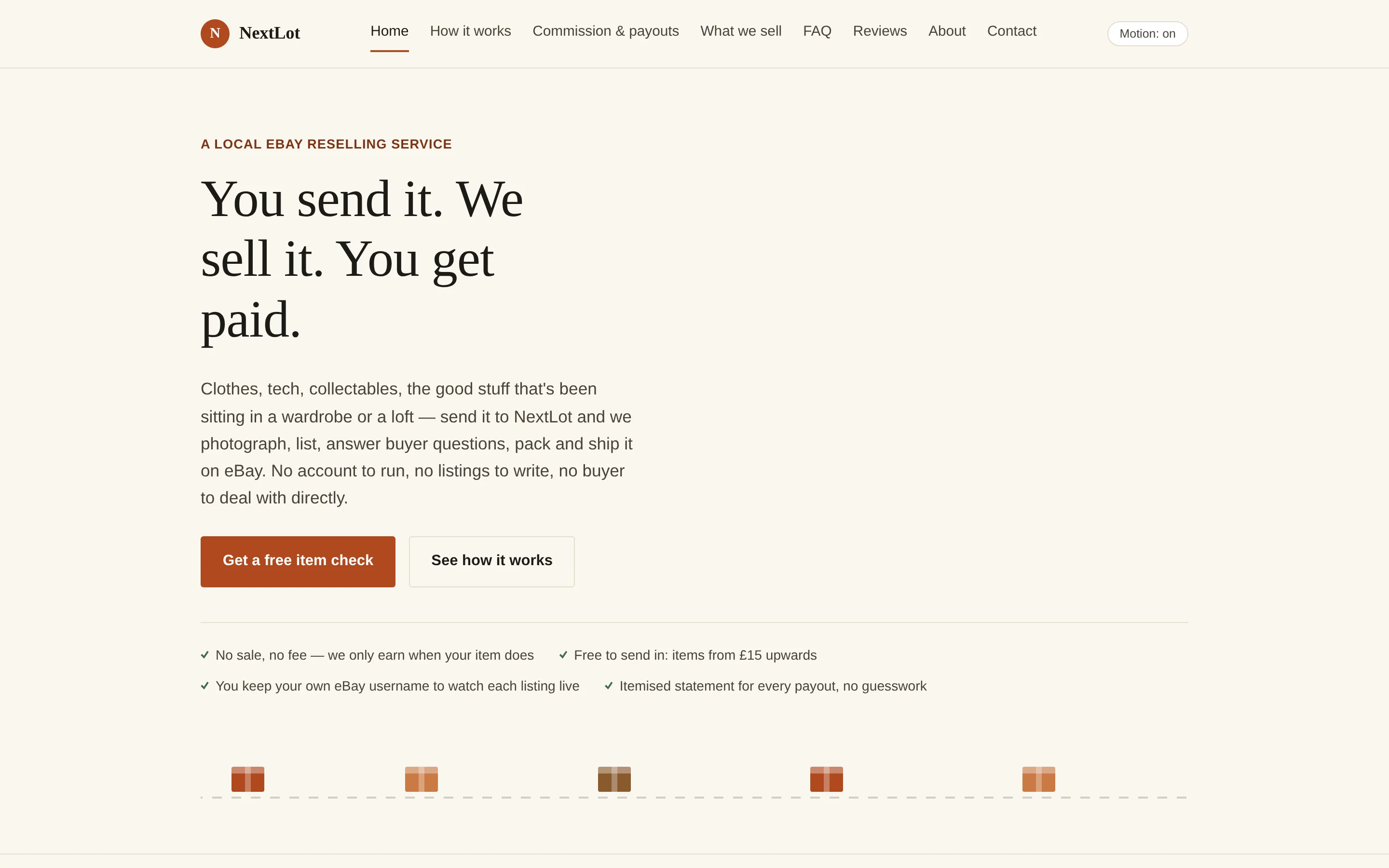
"You send it. We sell it. You get paid." — the whole business model in one line, before the first testimonial is even real. 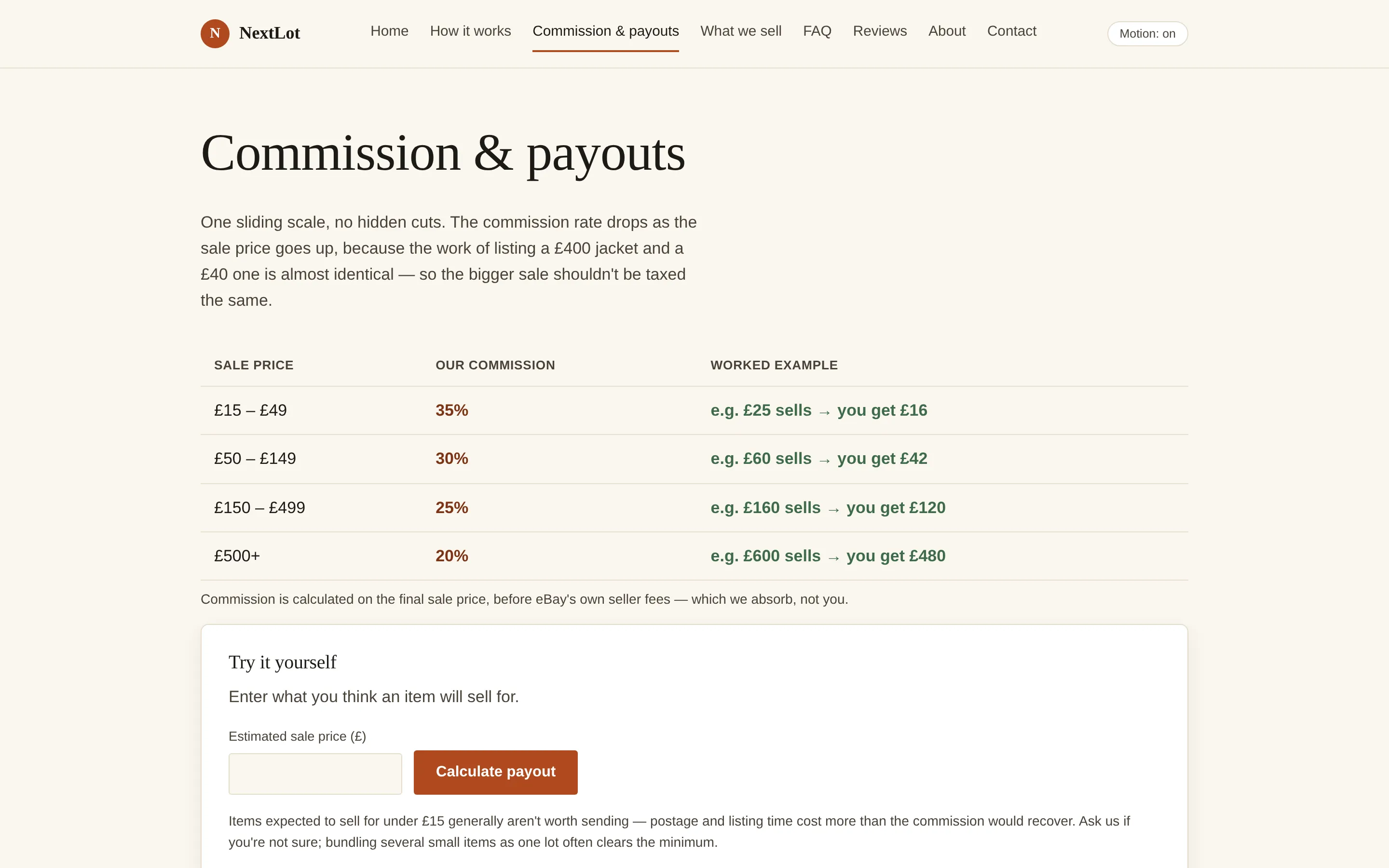
The sliding-scale commission table, plus a live calculator underneath it — type a price, see the payout. 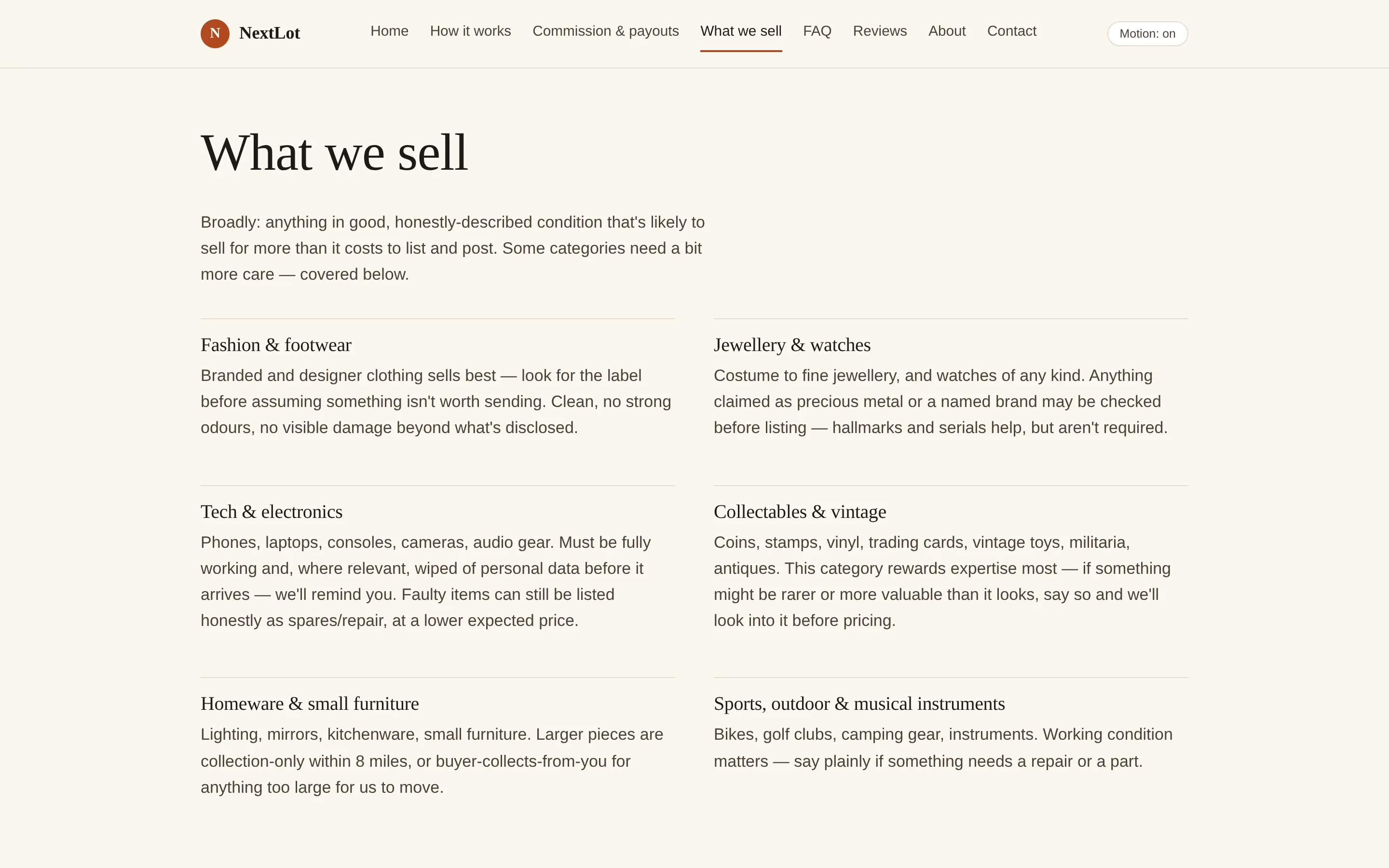
What's accepted and what isn't, stated as plainly as the prices. 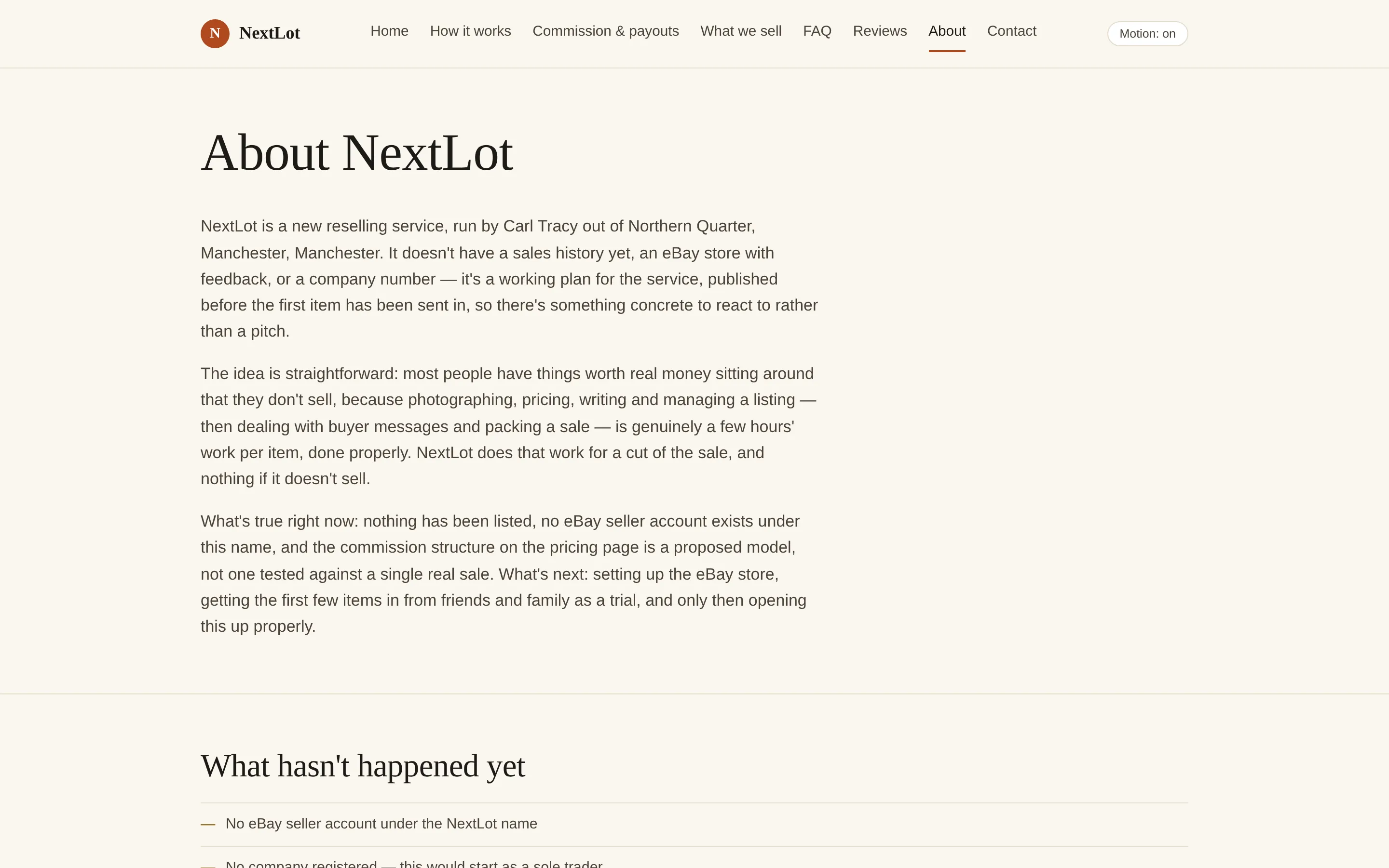
The About page's honesty, carried to its logical end: a section titled "What hasn't happened yet."